

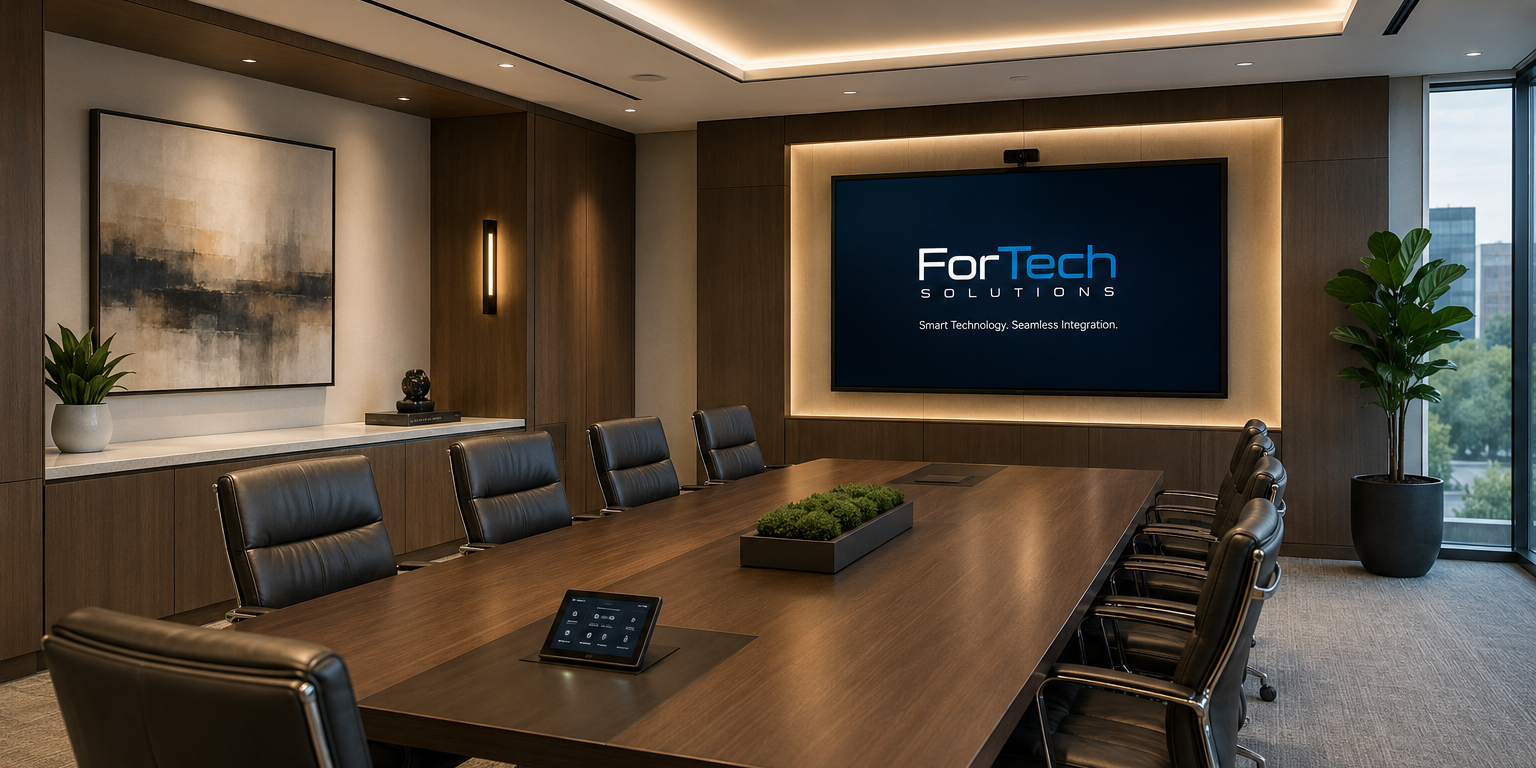
The Art of Invisible Technology: How Smart AV Design Hides the Hardware and Elevates the Experience

There’s a moment that every great technology integration aims for — the moment a client walks into a room, presses a single button, and everything just works. The lights dim. The shades drop. The presentation appears on screen. No one scrambles for a remote, hunts for a cable, or squints at a wall of blinking equipment.
That moment doesn’t happen by accident. It’s the result of intentional design — the art of making technology invisible.
At ForTech Solutions, this is one of the most powerful services we offer: seamlessly integrating AV, lighting control, motorized shading, networking, and security into a space so that the technology disappears into the architecture itself. The result? A space that feels effortless, sophisticated, and completely in control.
What Does "Invisible Technology" Actually Mean?
The push for invisible technology isn’t just an aesthetic preference. It’s a growing demand from architects, interior designers, and corporate real estate teams who understand that visible hardware undermines a room’s design intent.
When a law firm invests in a beautifully designed boardroom with custom millwork and curated finishes, the last thing they want is a rack of AV equipment stealing the show. When a luxury hospitality brand builds a high-end lobby experience, exposed speakers and visible wiring contradict the entire brand story.
This is why ForTech Solutions works side-by-side with architects and designers from the earliest stages of a project. Integrating technology invisibly is far easier — and far less costly — when it’s planned into the architecture, not retrofitted after the fact.
Invisible technology doesn’t mean technology that doesn’t exist. It means technology that doesn’t interrupt.
In a poorly designed space, technology is the first thing you notice — a tangle of cables snaking across a conference table, a projector hanging awkwardly from the ceiling, speakers bolted to the wall with exposed brackets. You’re constantly reminded that the technology is there, and every glitch makes it impossible to ignore.
In a well-integrated space, technology recedes into the background. Controls are intuitive. Devices are concealed. Cabling is routed invisibly through walls and ceilings. The space works for the people in it, not the other way around.
This is the difference between technology that’s installed and technology that’s integrated.
How We Make Technology Disappear: Key AV Approaches
1. Architectural Audio — Speakers You Can’t See
Modern in-ceiling and in-wall speaker technology has evolved dramatically. Today’s architectural speakers sit flush with the surface, can be painted over to match the ceiling or wall exactly, and deliver exceptional sound quality without any visible hardware. Some systems use flat-panel acoustic surfaces that look like wall art but function as full-range speakers.
For spaces where even flush-mount speakers aren’t invisible enough, we can specify solutions like audio beaming technology or directional sound systems that project audio into specific zones without traditional speaker placement at all.
2. Motorized Displays and Hidden Projection
Displays that rise from credenzas, projectors concealed within the ceiling that deploy on command, and screens that retract into casings when not in use — these are among the most impactful ways to preserve a room’s aesthetic when AV isn’t actively in use.
We also integrate displays into custom millwork, hiding them behind panels that slide, lift, or pivot open. When the meeting is over, the screen vanishes. The room returns to its designed state.
3. Wireless and Cable-Free Environments
Cables are the enemy of invisible technology. ForTech Solutions designs spaces around wireless AV distribution, wireless presentation systems, and PoE (Power over Ethernet) devices that eliminate the need for separate power runs and reduce visible infrastructure. Where cabling is necessary, we route it through walls, floors, and furniture during the construction phase — invisible by design.
4. Lighting Control That Blends In
Smart lighting control transforms a space instantly, but the controls themselves don’t need to shout about it. Slim, designer-grade keypads can be matched to any wall finish or face-plate style. In some installations, touch-sensitive surfaces integrate directly into architectural elements — a strip along a wall edge, a sensor embedded in a countertop — with no visible switch at all.
Paired with motorized shading that responds automatically to time of day, occupancy, or scene settings, lighting control becomes a completely seamless experience.
5. Clean Control Interfaces — or No Interface at All
Tablet-based control systems, flush-mounted touchpanels, and app-based interfaces have replaced the banks of buttons and remote controls that once cluttered every AV room. But the most invisible control of all is no control — occupancy sensors, automation schedules, and presence detection that trigger the right settings automatically, without anyone having to press a thing.
ForTech integrates control systems that learn from usage patterns, respond to environmental conditions, and anticipate what a space needs before anyone asks.
6. Equipment Rooms and Hidden AV Infrastructure
Behind every invisible technology space is a well-designed equipment room or rack system. Rather than placing AV processors, amplifiers, switchers, and network equipment inside the room itself, we locate them in dedicated closets or central equipment rooms — connected via structured cabling infrastructure that’s completely out of sight. Ventilation, cable management, and remote monitoring are all built into the design, so the system stays healthy and serviceable without ever disrupting the space.
The Business Case for Invisible Integration
Beyond aesthetics, there are tangible business benefits to getting this right.
Employee experience and productivity. Meeting rooms that are frustrating to use create friction, delay, and disengagement. A room where technology works invisibly and intuitively saves time in every meeting, every day. That adds up.
Brand perception. For client-facing spaces — boardrooms, showrooms, lobbies, hospitality suites — the environment sends a message. A space where everything works effortlessly communicates competence, attention to detail, and sophistication. Visible, messy, or malfunctioning technology does the opposite.
Long-term maintainability. Hidden technology that’s properly documented and designed with service access in mind is actually easier to maintain than ad-hoc installations. When everything is in its place, a technician can diagnose and resolve issues remotely or quickly without tearing apart a finished space.
Real estate value. Commercial spaces with high-quality, integrated smart building technology command stronger lease rates and attract higher-quality tenants. Invisible technology is an investment in the asset itself.
Where This Approach Works Best
Invisible technology integration is especially impactful in:
- Corporate boardrooms and executive suites — where design quality and meeting performance both matter
- Conference centers and multi-use spaces — where flexibility and reliability are non-negotiable
- Luxury hospitality — hotels, restaurants, and event venues where experience is the product
- High-end residential — where smart home technology should enhance living, not complicate it
- Healthcare and education — where intuitive, unobtrusive technology reduces barriers and improves outcomes
Designing with ForTech: Where Integration Begins at the Blueprint
The best time to plan for invisible technology is before a single wall goes up. ForTech Solutions partners with architects, interior designers, and general contractors during the design phase to identify pathways for cabling, equipment placement, acoustic treatment, and control interface locations — all resolved on paper before construction begins.
This pre-construction collaboration is what separates a space that’s truly seamless from one where the technology was forced in at the end.
If you’re designing a new space or planning a renovation, the conversation about technology integration should happen at the same time as the conversation about materials and finishes. We’re here for that conversation.
Ready to Make Your Technology Invisible?
At ForTech Solutions, we believe the best technology is the kind you don’t think about. We design, engineer, and install integrated AV, lighting control, shading, networking, and security systems that work together — quietly, reliably, and beautifully.
Let’s talk about what’s possible for your space.